How much do developmental fiction editors typically earn? What should you charge? Why do rates vary so much, and how you can aim for those higher ones?
If you’re thinking about becoming a developmental fiction editor, or adding this service to your editorial business, or creating a side gig that turns your passion for storytelling into extra income, this post will help you figure out if it’s financially feasible for you.
It covers: what editors are charging, why some charge far more than others, how to work out what you need to earn, and what you could realistically make.
Not sure what developmental editing actually is? Read this post first: What is Developmental Editing?
What developmental fiction editors are charging in the real world
These figures are based on publicly listed rates published by professional bodies, manuscript assessment agencies, a large freelance marketplace and established independent editors in the UK and US. They show what editors charge, not what they earn.
Dollar figures have been converted to pounds at roughly £0.75 to the dollar, the mid-market rate when I checked at the time of writing (11 November 2026), and everything is rounded. Per-1,000-word figures are my own calculations from the published rates, and the novel-length examples assume 80,000 words.
Developmental editing
- Per 1,000 words: Most editors charge around £20–27 ($27–36), though the full range runs from about £18 to £80 ($23–107).
- Premium end: Established independent editors charge £60–80 ($80–107) per 1,000 words.
- Per novel: An 80,000-word manuscript typically costs £1,600–2,200 ($2,100–2,900). At the premium end, it costs £4,800–6,400 ($6,400–8,500).
- Hourly: Published rates run from about £34 to £53 ($45–70). The suggested UK minimum is £42.66 ($57).
Manuscript critique, appraisal and assessment
- Flat fees: For a novel-length manuscript, the typical fee is £500–870 ($670–1,160), usually with a report of around 2,000–3,500 words.
- Per 1,000 words: That works out at roughly £6–11 ($8–15). The marketplace average is higher at £19.50 ($26), or about £1,560 ($2,080) for an 80,000-word novel.
- Premium end: Established independent editors charge around £30 ($40) per 1,000 words, or £2,400 ($3,200) for 80,000 words.
Here’s a simplified view:
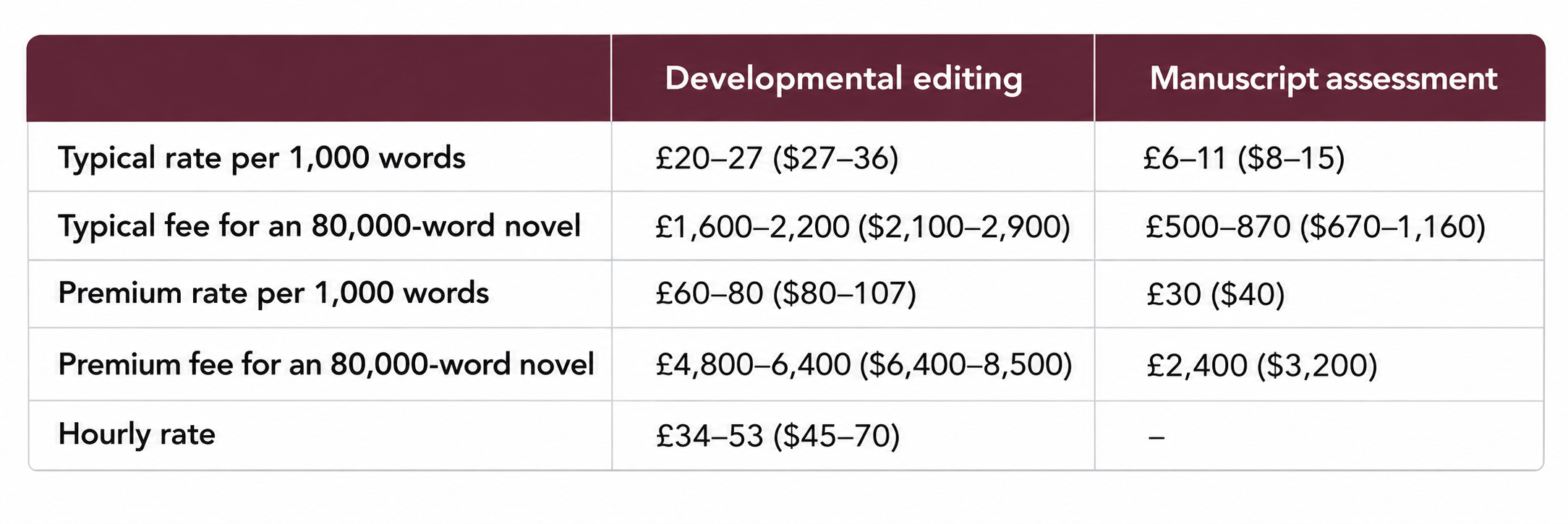
I couldn’t reliably work out an hourly rate for manuscript assessments, as editors don’t publish one and the deliverables (such as report length and depth) vary. However, they typically take much less time than a full developmental edit.
Key factors affecting earnings
The rates above vary widely, with some editors charging two to four times the typical amount for the same service. I believe several factors explain the gap, and while some depend on an editor’s circumstances, others can be shaped over time.
Individual situation
Some factors depend on an editor’s own circumstances and the path they choose.
- Experience: As with all jobs, the more you do, the more you learn. Experienced editors can apply more honed, real-world knowledge to a project, which is value worth paying for, especially if their past clients have been successful.
- Background: If an editor has a relevant skill or experience (such as time spent as a commissioning editor in a publishing house, or being a published author), this can give them a competitive edge.
- Client source: Editors must decide for themselves whether they will thrive by working for a larger agency or through a marketplace, or whether they are better positioned to go it alone. With the former, they lose part of their fee to commission, but with the latter they must spend more time marketing. Successful editors know which works best for them.
What all editors can control
Other factors are within every editor’s control, whatever their background.
- Reputation: Not quite the same as experience, reputation is affected by client successes and their experience of the service and editor (were they good to work with …?), and authority and competency signals (such as awards, media appearances, memberships to reputable editorial societies, and more).
- Brand positioning: This has a massive effect on earning potential. Editors who present themselves in a way that appeals to their ideal clients and demonstrates their individualism and professionalism stand out for all the right reasons.
- Efficiency and boundaries: The quicker an editor works on a project with a set fee, the more they earn per hour. Similarly, editors who are clear on the project boundaries and do not allow for ‘scope creep’ operate with greater capacity.
Want to learn more about branding and building an editor website that converts? Take a look at this course: The Visible Editor.
Where does training fit in?
Anyone can call themselves an editor and start trying to find paying clients. There are no regulating bodies or legal requirements like there are for lawyers or doctors.
Some editors have enough background knowledge and transferable skills and experiences to become successful without formal training, but when you don’t have these things, editorial training provides an essential foundation.
Training won’t guarantee higher rates, but it can certainly help. It builds your skills, helps you work more efficiently, and gives you credentials that feed into your reputation.
Doing the sums
Earning potential isn’t only about what editors charge. Earning potential is just that: potential. You can’t just copy what another editor is doing because, as we’ve just seen, there are lots of factors that go into whether that editor can be successful charging that rate.
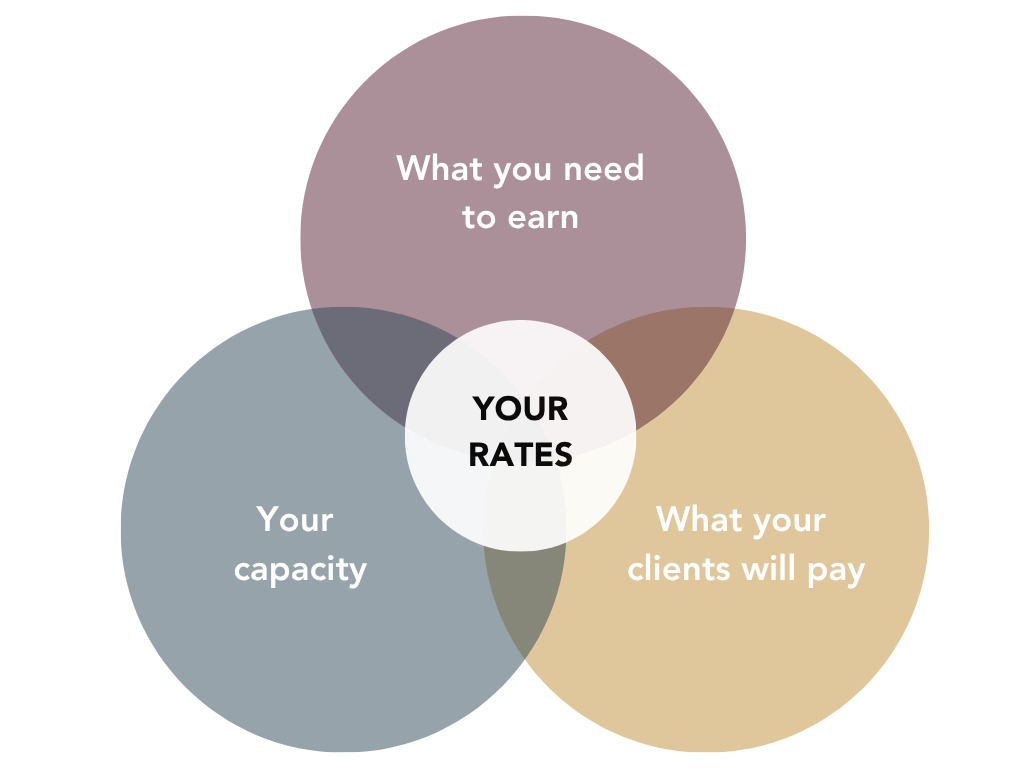
You also need to think about whether what you can earn from developmental editing matches what you personally need financially. Setting your rate is part of the puzzle, and there are a few things that come into play here.
- What you need to earn: This depends on your circumstances and where you live. Remember that the fee isn’t what you keep. Tax and social contributions (which vary by country), business costs, unpaid time (holidays, sickness, marketing and admin) and exchange rates all reduce it.
- Your capacity: This is how many projects you can realistically complete in a year, which depends on how quickly you work, how much time you spend on running the business and finding clients, and how much time you have available. (Raise your hand if you, too, can only work during school hours!)
- What your clients will pay: The rates in the table above show what the market currently supports, from typical to premium. As you can see, these vary widely. A potential client is more than ‘someone who is looking for an editor’. There are loads of factors at play, but the bottom line is that you need to position yourself in a way that appeals to clients who are capable of hiring you.
Where these three things overlap, you have workable rates.
Where they don’t, there are options: increase your capacity, build the reputation that supports higher rates, or add other income.
In fact, many editors who offer developmental editing don’t rely on it alone. It’s usually one service among several, such as copy-editing or proofreading, and for some it’s a side business alongside other work.
What a developmental fiction editor could actually earn
Let’s look at some concrete examples. I’ve used the fees from the table for an 80,000-word novel here, and all figures are before tax, business costs and unpaid time. Developmental editing and manuscript assessment are two different services, so I’ve separated these out.
Remember: rate, speed and the number of projects you can take on make the biggest difference, which is why many editors combine developmental editing with other services, work towards premium rates, or do it as a side income.
Developmental editing
Six typical edits a year would bring in about £9,600–13,200 ($12,800–17,600), a realistic side income or as part of a wider mix of services. One a month would gross about £19,200–26,400 ($25,600–35,200), and this is closer to a full-time workload. At premium rates, six edits a year would bring in £28,800–38,400 ($38,400–51,200).
Manuscript assessment
Assessments are priced much lower, so they take more projects to add up – but you can earn more per hour with assessments, and they take much less time overall. Ten a year at typical fees would bring in about £5,000–8,700 ($6,700–11,600), as a side income or as part of a wider suite of services, while ten at premium rates would bring in about £24,000 ($32,000) – much rarer, but not impossible.
Developmental editing can be a rewarding income, whether it’s a side gig or the heart of a full-time business. The editors who do best build their skills, reputation and business sense over time. If you’d like help laying those foundations, my self-paced developmental editing courses at Liminal Pages are a good place to start.